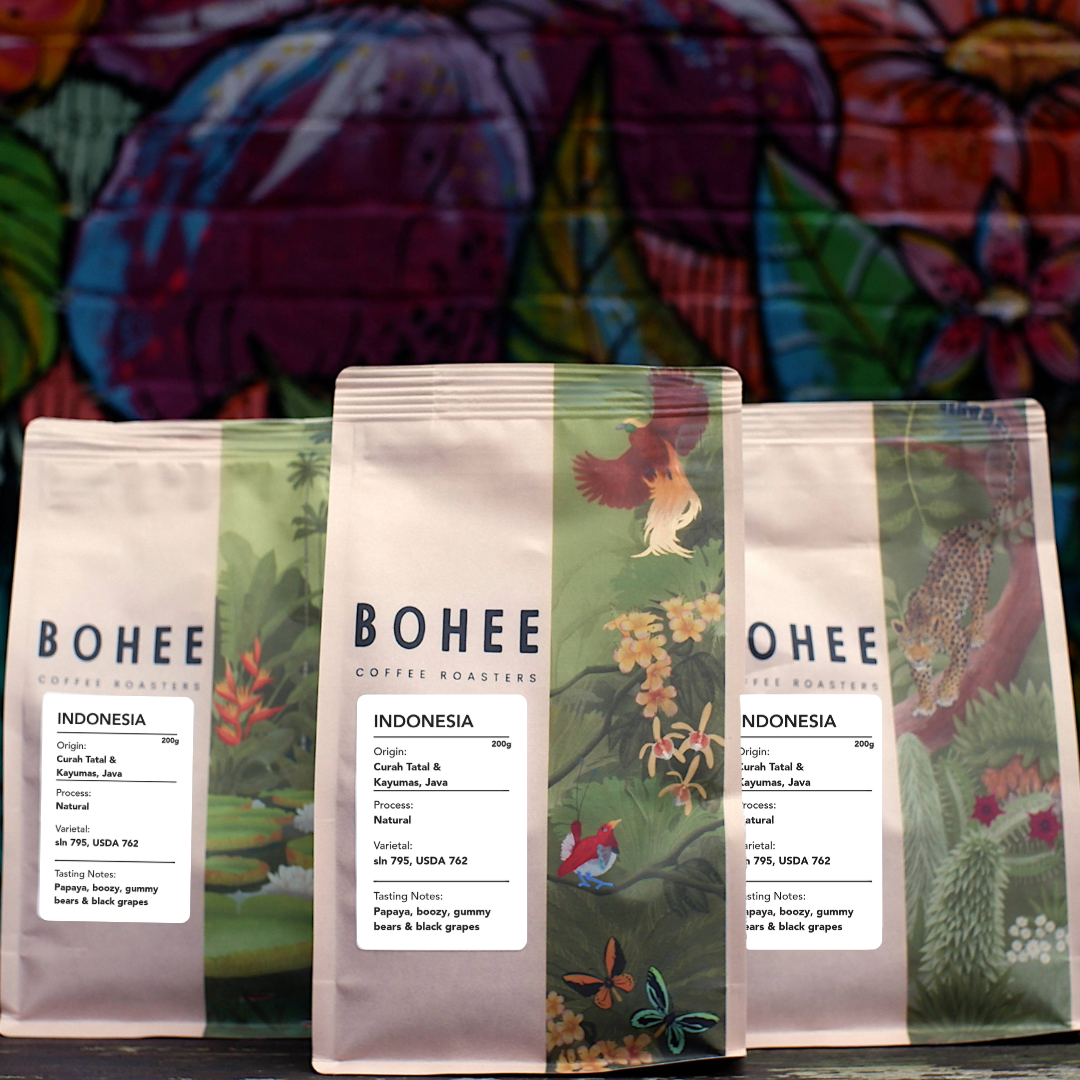
Java Kayumas
Java Kayumas
Couldn't load pickup availability
We are really pleased to be able to support the members of the Koperasi Surya Abada Kayumas Cooperative on Java by choosing this natural coffee which we think is full of bright juicy flavours. The cooperative is made up of family-owned farms in the neighbouring villages of Curah Tatal and Kayumas who each produce 5-6 tonnes of cherries per hectare which are processed in one of three centralised processing centres belonging to the cooperative.
Tasting Notes: Papaya, boozy, gummy bears & black grapes
Country: Indonesia
Region: Curah Tatal & Kayumas, Java
Altitude: 1000 - 1600m
Varietal: sln 795, USDA 762
Process: Natural
Roast: Light
The Story:
Based in the East Javan regency of Situbondo, members average 2ha each, somewhere around 1500 trees. In total, the cooperative covers nearly 400 hectares. Surrounding them, coffee is mostly grown on government owned estates. Three collection and processing centres are centralized to allow members access to processing facilities quickly. Resources are pooled to the benefit of the group.
Mainly producing the traditional Giling Basah, the co-op have recently expanded into anaerobic naturals and wet hulled anaerobics. They share knowledge on sustainable agroforestry, irrigation systems, landslide prevention, planting distances between trees, shade & fruit tree planting, hunting bans and biodiversity protection. All vital in an area that is relatively remote on the volcanic slopes of the Ijen Plateau. They also produce their own organic manure from cattle, goats, and poultry. Community infrastructure has also been funded in this way, with roads, toilets, warehouses and waste tanks all being built since 2020. Trainings are provided in agriculture, but also wider workshops have been held to encourage youth in coffee farming and rebalancing gender inequalities whilst considering the cultural diversity too. The roads have allowed motorbikes to assist in harvest, speeding the time taken for delivery of cherry and increasing the load per journey.
The Process:
Beans are cleaned and sorted, and undergo a fermentation stage in tile lined tanks.
Raised beds are used for maximum airflow and quick drying, with tarpaulins spread out for the final stages where drying is slower.
Cherries are dried to export levels at Indokom, the exporter’s milling facility where the skin and parchement is also removed.